Homeschool Reading Struggles and How to Turn them Around
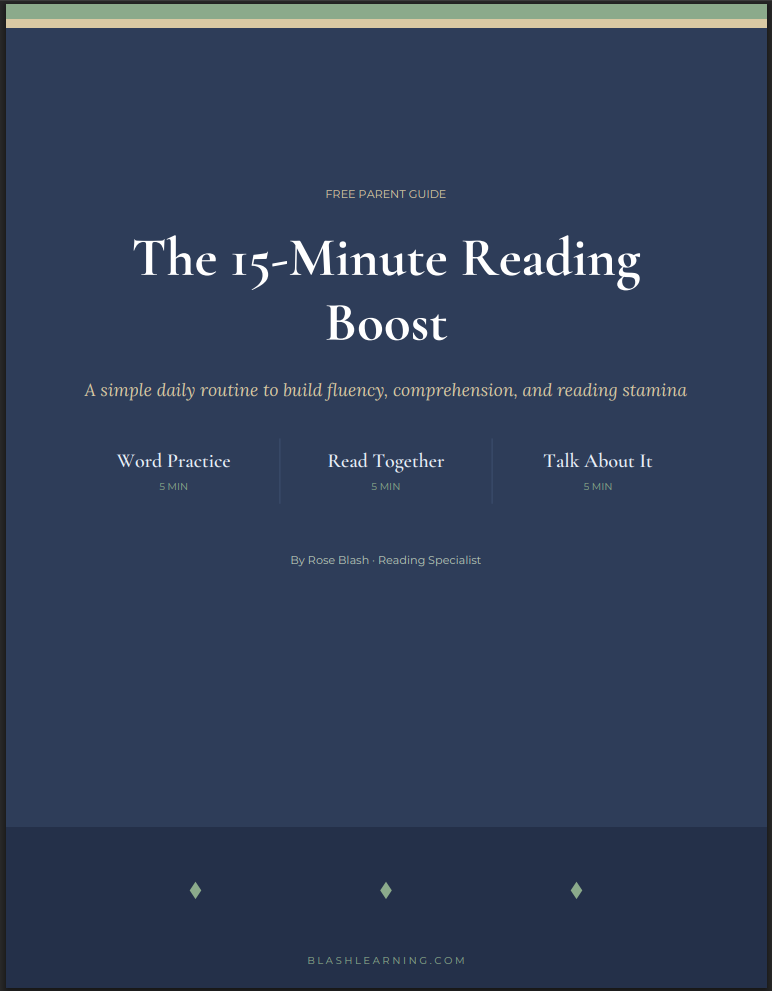
Take the first step in turning things around by downloading The 15-Minute Reading Boost.
If homeschool reading struggles are making your kitchen table feel like a battlefield, you’re not alone, and you didn’t cause this. You’ve cleared the table, set out the book, and sat down across from your child with your most encouraging smile.
And then it starts: the squirming, the sighing, the eyes drifting toward the window. Reading time has become the part of your homeschool day that makes your stomach drop. You find yourself wondering whether pulling your child out of traditional school, or never putting them in at all, somehow made things worse.
It didn’t. But that quiet guilt? It’s one of the most common things homeschooling moms carry when reading isn’t clicking. Rose Blash, founder of Blashlearning, has walked alongside hundreds of families in exactly this place. And she’ll tell you the same thing: reading difficulties are common, they’re identifiable, and with the right approach, most struggling readers make meaningful progress. You need to know what you’re looking at.
By the time you finish this article, you’ll know what’s causing the struggle, what you can do today, and exactly where to turn next.
What homeschool reading struggles actually look like at each stage
recur in homeschool settings, and each one points to something different happening beneath the surface. Not all reading struggles look the same, and misreading the symptom leads to the wrong fix. Three patterns show up repeatedly in homeschool settings, and each one points to something different happening under the surface.
Phonics plateaus: when sounding out stops working
What usually happens is that instruction moves too quickly through the alphabetic code before earlier patterns are covered. A child who seemed to be cruising through letter sounds suddenly hits a wall. Progress stalls, and it feels like the method stopped working. What’s usually happening is that instruction moved too quickly through the alphabetic code before earlier patterns were truly locked in.
There’s also a frustrating gap some kids fall into: they can recite phonics rules in isolation but can’t apply them when they’re actually reading a sentence. That often reflects a transfer or blending gap rather than a phonics failure, and it calls for targeted practice with decodable text and explicit blending work. For more on how instruction needs to stay flexible and connected to reading practice, see phonics and flexibility
Sight word confusion and reading avoidance
shapes of words, and refusing to try at all. If your child suddenly needs a snack every time reading starts, or finds something deeply fascinating about the ceiling, avoidance is already a symptom. Struggling readers often develop workarounds: guessing from pictures, memorizing the shape of words, and refusing to try entirely.
These aren’t signs of laziness. There are signs that reading feels like failure, and the brain is protecting itself. Avoidance is a common early visible signal, not the root problem. Kids who feel incompetent shut down, and that emotional layer has to be part of any solution.
Comprehension gaps: reading the words, missing the meaning
This one gets overlooked the most. Your child reads a passage aloud and sounds fluent. Then you ask what it was about, and you get a blank stare. Decoding and comprehension are two separate skills, and a child can be competent at one while struggling with the other.
Because these kids “sound like they’re reading fine,” their comprehension gap often goes unaddressed for months or even years.
Late starter or reading difficulty? What homeschool reading struggles look like.
Reading milestones deserve some perspective before you spiral into worst-case thinking. Letter reversals before age 8 are developmentally normal. A 6-year-old who loves stories but can’t yet decode independently may need more time and more exposure. Gradual progress without physical strain is a good sign. Not every child who struggles at 5 has a reading disability.
Red flags of homeschool reading struggles

Some warning signs are worth taking seriously regardless of age. Watch for active avoidance of reading, consistent guessing from pictures instead of sounding out words, fatigue or headaches after short reading sessions, sight words that never stick despite repeated exposure, and spelling that stays phonetically inconsistent past age 8.
A family history of dyslexia raises the stakes for acting early. These signs together paint a clearer picture than any single behavior alone.
The age-8 threshold and why it matters
Age 8 comes up repeatedly in literacy research, and for good reason. By this stage, most neurotypical readers have cracked the alphabetic code. A child who is still struggling to decode basic words after age 8 likely needs more than patience.
This isn’t a diagnosis. It’s a prompt to stop waiting and start acting with intention, because the research is detailed: early intervention produces far better outcomes than late intervention.
Quick wins for homeschool reading struggles: where to start today
When reading feels stuck, the instinct is to buy a new curriculum. A different program, a fresh start, something that will finally work. But the problem usually isn’t the curriculum. It’s the absence of a consistent daily structure where reading practice can actually build on itself.
Research on distributed practice consistently shows that short, repeated daily sessions outperform sporadic longer ones for struggling readers, so a little every day beats a lot once in a while.
How the free 15-Minute Reading Boost can help right now
You love your child deeply — and that love is exactly why you picked up this guide. You may be
wondering if you’re doing it right, whether your child is keeping up, or what to do when the tears
start at the reading table.
Attention
Those questions don’t mean you’re failing. They mean you’re paying attention. And paying
Attention is where good teaching begins.
This guide gives you a simple, 15-minute structure built around the three skills that matter most
in reading growth:
Rose Blash built her free 15-Minute Reading Boost specifically for homeschool moms who feel stuck and aren’t sure where to start. It includes daily routines, fluency fixers, comprehension questions, narration prompts, and a reading stamina ladder.
It’s not a replacement for a full curriculum. It’s a structured daily framework designed to take the guesswork out of each lesson, so you walk into reading time knowing exactly what to do. If you do nothing else after reading this article, grab that free resource at Blashlearning.com.
Multisensory activities That help with Homeschool Reading Struggles
Some of the most effective multisensory reading interventions require nothing more than a cookie sheet and a handful of sand. For an accessible overview of how multisensory activities support reading development, see this guide to multisensory activities.
Hands-on strategies for decoding and phonics work
Multisensory techniques are rooted in Orton-Gillingham methodology, which forms the backbone of the most evidence-backed reading programs available. Here are three fun activities you can use today:
- Sand tray writing: Spread sand (or salt) on a cookie sheet. Have your child write a letter with their finger while saying the sound aloud, then blend multiple sounds into a word. This activity builds fine motor skills, reinforces letter recognition, and strengthens phonemic awareness. You can see how tactile and visual senses are engaged.
- Letter tiles with sound tapping: Build a word like “cat” with tiles or magnets. Touch each tile, say its sound, and tap a finger to the thumb for each phoneme. Then sweep the thumb across all fingers to blend the whole word. Sound tapping creates a brain-friendly learning environment that engages the senses of hearing and sight simultaneously. Children make the connection between what the letter looks like and its corresponding sound much faster
- Air writing: Have your child write a letter in the air with their whole arm, as if writing on a giant chalkboard, while saying the sound. Big movement, big memory.
These aren’t arts-and-crafts extras. They give struggling readers a physical, sensory experience of a word’s structure, which is exactly what the brain needs when visual processing alone isn’t cutting it.
Building fluency without the frustration
The “Read It, Build It, Write It” routine is a short daily activity that builds fluency through multiple channels. Read a word, build it with tiles while saying each sound, then write it to lock it into memory. The whole thing takes about five minutes and is highly repeatable.
One common mistake parents make is forcing a child to reread the same passage over and over until it starts to feel like punishment. Paired reading and repeated reading work much better when you lead with praise for accuracy first, before you ever mention speed.
Strengthening comprehension through narration
Narration is a well-regarded comprehension strategy with roots in the Charlotte Mason tradition, and one of the most underused tools in homeschool reading instruction. The technique is simple: after reading a passage together, ask, “Tell me back what you heard.” No worksheet, no questions.
Just talking.
This single practice builds listening comprehension, oral language, and memory at the same time. The Blashlearning 15-Minute Reading Boost includes narration prompts that are ready to use so you never have to wonder what to say next.
For additional reading comprehension information, take a look at How to Help Your Child Improve Reading Comprehension at Home. You will find more encouragement and helpfu tools here.
When to seek a formal reading assessment for your homeschooled child
Consider a formal evaluation if your child shows persistent warning signs or has stopped making progress despite consistent daily instruction, especially between ages 6 and 8. A child who is significantly behind expected reading benchmarks and showing two or more of the red flags listed above deserves a closer look. Early screening can begin as young as age 5 and a half, and waiting rarely helps. If you’re seeing those signs, the kindest thing you can do is take action.
Several types of professionals can evaluate reading difficulties. An educational psychologist can conduct full psychoeducational testing. A speech and language pathologist can screen specifically for phonological processing weaknesses. A neuropsychologist assesses broader processing challenges, while school psychologists often provide evaluation support through the public school system.
Homeschooled children can frequently access evaluations through their local public school district at no cost under federal law. When you search, look for professionals who specialize in learning disabilities and use evidence-based assessment tools rather than those with only a general practice.
Evidence-based programs to Help Homeschool reading Struggles
Here are some additional thoughts on how to turn reading time from a struggle to a time of joy. Be encouraged! You’ve got this!
Before you spend money on a new program, ask three questions: Is it structured and sequential? Is it multisensory? Does it require minimal prep for the parent? Programs built on Orton-Gillingham principles or the Science of Reading have the strongest evidence base.
Position statements from organizations like the International Dyslexia Association consistently recommend systematic phonics instruction over approaches that rely primarily on whole-word memorization or teaching kids to guess from context instead of decode.
Here are four programs families use most often:
- All About Reading: Low prep, reusable across multiple children, mastery-based, and approximately 20 minutes a day. A practical, parent-friendly option for homeschool families.
- PRIDE Reading Program: Fully scripted, Orton-Gillingham based, and well-suited for dyslexia support. The scripting removes much of the instructional guesswork.
- Logic of English: Affordable at around $15 per workbook, rule-based, and well-suited for kids who want to understand why English works the way it does.
- Barton Reading and Spelling: Thorough and well-supported, with solid training for parents. Higher cost, but levels can be resold to offset the investment.
Struggling readers who need fluency-building alongside their core program often benefit from a short daily supplement. Blashlearning’s fluency fixers, included in the free 15-Minute Reading Boost, pair naturally with any of these programs and add the kind of consistent daily repetition that makes progress compound over time.
You can beat those homeschool reading Struggles
Picture that mom at the kitchen table again. She’s not failing. She’s paying attention, she’s asking the right questions, and she’s looking for real answers. That’s exactly what a good teacher does.
Recognizing reading struggles early and responding with the right tools isn’t a sign that something went wrong. It’s a sign that something is going right. The struggle is real, and the solutions exist, you just need a solid starting point.
Be sure to check out the blog post How to Teach Your Child To Read at Home for further information and insightst on teaching your child to read.
If homeschool reading struggles are making lessons stressful, the simplest next step is to download Rose Blash’s free 15-Minute Reading Boost at Blashlearning.com.
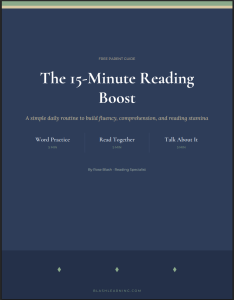
It gives you a clear daily structure, practical activities, and the grounded confidence that comes from knowing exactly what to do tomorrow morning when you sit down across from your child.